

 |
 |
 |
 |
 |
 |
 |
 |
 |
 |
 |
 |
In Great Britain the time is #LSTimeFormat(Now(),"HH:mm")#
on
#DayofWeekAsString(DayOfWeek(Now()))# #LSDateFormat(Now(),"dd mmm
yyyy")#
Look
up and book your stay online using our online search which opens
in a new window.
Hadrian's Wall and Hexham.
"Some of the great England monuments of antiquity are hard to take in at a glance… You need a guide, a knowledgeable person to explain the significance of dilapidated stonework. The Wall is an exception. You can see exactly what the Romans were up" --John Hillaby, Greenhead Journey Through Britain, 1970
|
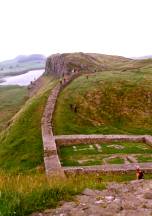
In 55 and 54 BC, Julius Caesar launched two swift Roman invasions of Southeast England from his base in Gaul, his success proving that Britain lay within the Roman grasp. The full-scale assault began under Claudius in 43 AD and, within forty years, Roman troops had reached the Firth of Tay.
In 83 AD, the Roman governor Agricola ventured farther north, but Rome subsequently transferred part of his army to the Danube, and the remaining legions withdrew to the frontier which was marked by the Stanegate, a military roadway linking Carlisle and Corbridge. Emperor Hadrian, who toured Roman Britain in 122 AD, found this informal arrangement unsatisfactory. His imperial policy was quite straightforward - he wanted the empire to live at peace within stable frontiers, most of which were defined by geographical features.
In
northern Britain, however, there was no natural barrier and so Hadrian
decided to create his own by constructing a 76-mile wall from the Tyne
to the Solway Firth -; "to separate the Romans from the barbarians," according
to his biographer. It was not intended to be an impenetrable fortification,
but rather a base for patrols that
could push out into hostile territory and a barrier to inhibit movement.
It was to be punctuated by milecastles, which were to serve as gates,
depots and mini-barracks, and by observation turrets, two of which were
to stand between each pair of milecastles. Before the wall was even completed,
major modifications were made: the bulk of the garrison had initially
been stationed along the Stanegate, but they were now moved into the
wall, occupying a chain of new forts, which straddled the wall at six-
to nine-mile intervals. These new arrangements concentrated the wall's
garrison in a handful of key points and brought them nearer the enemy,
making it possible to respond quickly in force to any threat. Simultaneously,
a military zone was defined by the digging of a broad ditch, or vallum,
on the south side of the wall, crossed by causeways to each of the forts,
turning them into the main points of access and rendering the milecastles,
in this respect, largely redundant.
The revised structure remained in operation until the last Roman soldiers left in 411 AD. Most of Hadrian's Wall disappeared centuries ago, yet walking or driving its length remains a popular pastime. There are plans to complete a long-distance footpath along the entire course of the wall, but disputes with landowners look set to make this a long-term project; currently, only certain sections are accessible, but these are more than enough to give an idea of the whole.
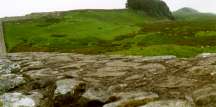 |
The wall snakes across the country, always commanding the high ground. Every Roman mile there was a milecastle (a small fort) and in between each pair of mile castles were 2 watch towers Messages could be flashed up and down the length of the wall very quickly if there was an attack. Any invaders from the north had first to cross open ground, then a ditch 27feet wide and 9 feet deep, before they got to the wall. After the 1745 Jacobite uprising, sections of the wall were destroyed in order to use the stone for a military road which would allow George's troops to move quickly from east to west. Today the best preserved sections of the wall are in the centre of the country, round Housesteads. The remoteness of the area, and the bleakness of the landscape have meant that little human habitation or farming have ventured there.
Approached from Newcastle along the valley of the Tyne, via the Roman museum and site at Corbridge, the prosperous-looking market town of Hexham, with its fine eleventh-century abbey, makes an ideal base. Most visitors stick to the best-preserved portions of the wall, which are concentrated between the hamlet of Chollerford, three miles north of Hexham, and Haltwhistle, sixteen miles to the west.
It's here, especially between Housesteads and Steel Rigg, that the wall is at its most beautiful, as it clings to the edge of the Whin Sill, a precipitous line of dolerite crags towering above the austere Northumberland National Park moorland. Walking this part of the wall couldn't be easier: a footpath runs along the top of the ridge, incorporating a short stretch of the Pennine Way, which meets the wall at Greenhead and leaves at Housesteads, where it cuts off north for Bellingham. Scattered along this section are a variety of key archaeological sites and museums, notably Chesters Roman Fort and Museum, near Chollerford, the remains of Housesteads Fort and that of Vindolanda, and the milecastle remains at Cawfields, north of Haltwhistle
We have a range of discussion forums available, to join the discussion on Hadrian’s Wall, Hexham, Northumberland, or England simply select one of the links below:
Hadrian’s
Wall Discussion Forum
Hexham
Discussion Forum
Northumberland
Discussion Forum
England
Discussion Forum
Latest in the Forums
There are 0 active discussions.
There are
There are 0 active polls.
There are

© and ™ 1997-
Company Information