

 |
 |
 |
 |
 |
 |
 |
 |
 |
 |
 |
 |
In Great Britain the time is #LSTimeFormat(Now(),"HH:mm")#
on
#DayofWeekAsString(DayOfWeek(Now()))# #LSDateFormat(Now(),"dd mmm
yyyy")#
Look
up and book your stay online using our online search which opens
in a new window.
Hexham Abbey
(The priory and parish Church of Saint Andrew)
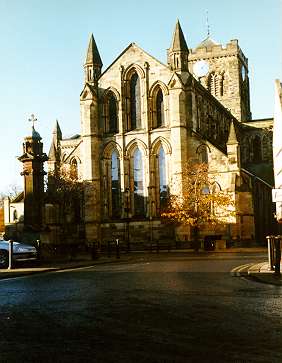
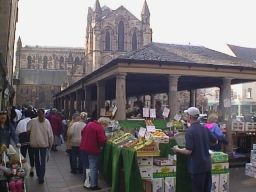
The Priory Church of St Andrew, still dominates the west side of the Market Place.
|
Hexham Abbey from the Market Square. |
 |
Entry is through the south transept, where there's a bruised but impressive first-century tombstone honouring Flavinus, a standard-bearer in the Roman cavalry, who's shown riding down his bearded enemy. The memorial lies at the foot of the broad, well-worn steps of the canons' night stair, one of the few such staircases providing access from the monastery to the church to have survived the Dissolution.
|
Left: The upper gallery of the Sanctury Chamber from the night stair balcony Below: The North trancept seen from the Night Stair balcony |
|
|
|
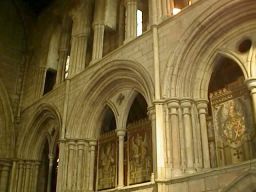
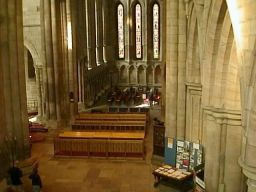
Beyond, most of the high-arched nave dates from an Edwardian restoration and it's here that you gain access to the crypt, a Saxon structure made out of old Roman stones, where pilgrims once viewed the abbey's reliquaries
|
The east end window, rebuilt in 1860 |
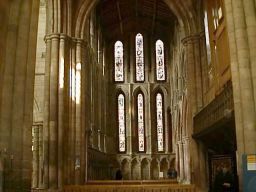
The nave's architect also used Roman stonework, sticking various sculptural fragments in the walls, many of which he had unearthed during the rebuilding. At the end of the nave is the splendid sixteenth-century rood screen, whose complex tracery envelops the portraits of local bishops. Behind the screen, the chancel displays the inconsequential-looking frith stool, an eighth-century stone chair that was once believed to have been used by Saint Wilfrid, rendering it holy enough to serve as the medieval sanctuary stool.
Nearby, close to the high altar, there are four panels from a fifteenth-century Dance of Death, a grim, darkly varnished painting. Of Wilfred's Benedictine Abbey, only the crypt and apse still remain. The building that stands today was mainly built about 1170-1250 in the Early English style of architecture and the choir, north and south transepts and the cloisters date from this period. The east end was rebuilt in 1860 and the nave, incorporating some of the earlier church stones, built in 1908.
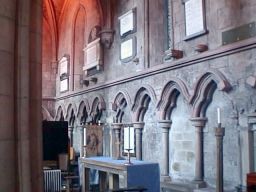 |
In 1996, an additional chapel was created on the east side of the North Choir Aisle and called St Wilfred's Chapel. It offers solace and tranquility for prayer or simply inner reflection. Since the Dissolution of the Monasteries in 1537, this magnificent building with it's stunning architecture has been the parish church of Hexham and remains the centre for worship and witness to the Christian faith.
Latest in the Forums
There are 0 active discussions.
There are
There are 0 active polls.
There are

© and ™ 1997-
Company Information